


Personalized expert advice for B2B
Every project is different. Our solar experts provide practical advice on module selection, inverters, storage systems, and system compatibility – tailored to your specific project.

Modal Title



Solplanet
Solplanet Charging Station Apollo SOL H-WS Series without Cable and with 14A Regulation


EcoFlow
EcoFlow PowerInsight EU schwarz 10 Zoll Touchscreen Hausenergie Monitor Display


EcoFlow
EcoFlow Stream Microinverter Balkonkraftwerk Wechselrichter für Solarmodule PV


Anker Solix
Anker EverFrost Powered Cooler 30 Battery 299Wh -20°C to +20°C with Spare Battery


Anker Solix
Anker EverFrost Cooler Battery 299 Wh Replacement Battery for EverFrost Coolers


Anker Solix
Anker EverFrost Powered Cooler 30 with 299Wh Battery, -20°C to +20°C, App Control


Anker Solix
Anker SOLIX FS20 Solar Panel 4x225W Flexible ETFE Coating Portable Off-Grid


A PV system converts sunlight into direct current via solar modules. An inverter converts this into grid-compliant alternating current and controls the feeding process. A mounting system fixes the solar panels to the roof, facade, or flat roof. Optionally, home storage systems, smart meters, and energy management increase self-consumption. Cables, DC connectors, and surge protection complete the system.
Bei Terra Energy finden Sie Solarpanele, Wechselrichter, Balkonkraftwerke, Heimspeicher, Powerstations, Smart Meter, Ladestationen, Wärmepumpen, Notstromboxen, Energie- und Verbindungskabel, Adapter, Halterungen und Montagezubehör. Dadurch lassen sich einzelne PV-Komponenten oder komplette Solarstromlösungen für private, gewerbliche und mobile Anwendungen zusammenstellen.
Solarbetriebe und Installateure profitieren bei Terra Energy von einem herstellerunabhängigen Sortiment, persönlicher Fachberatung, schnellen Angebotsprozessen, festen Ansprechpartnern und kompatiblen Komplettlösungen aus einer Hand. Das ist besonders wichtig, wenn PV-Module, Wechselrichter, Speicher, Smart Meter und Montagezubehör technisch sauber aufeinander abgestimmt werden müssen.
The yield depends on location, orientation, shading, and module performance. In Germany, well-planned photovoltaic systems often achieve between 850 and 1100 kilowatt-hours per kilowatt-peak. South and East-West orientations deliver similar annual energy but differ in daily distribution. An inverter with a suitable MPP voltage window ensures efficiency. Monitoring helps compare real values with the yield forecast.
A battery storage system increases self-consumption and reduces grid purchases in the evening hours. It is economically viable if load profiles are high in the evenings or if heat pumps and wallboxes utilize PV surpluses. Important key figures are usable kilowatt-hours, C-rate, and cycle stability. AC-coupled storage systems are suitable for retrofitting, while hybrid inverters integrate the storage system at the DC level in new constructions. Intelligent energy management optimizes charging times and self-sufficiency.
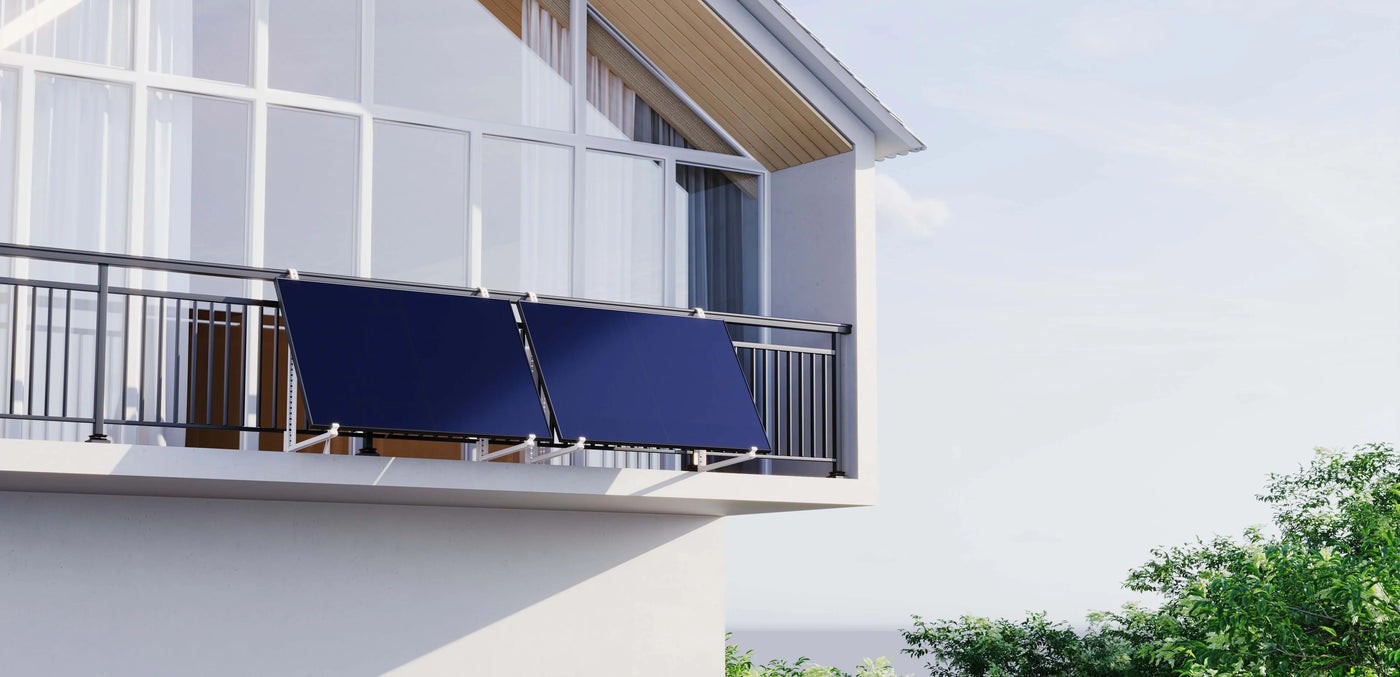
Plug-in solar devices up to 800 watts AC are permissible in Germany; the module output per device can be higher. Registration in the market master data register is required. Many grid operators accept operation until the meter is replaced, after which a bidirectional meter is usually installed. An energy plug connector is recommended. Our kits include suitable solar panels, inverters, and connection accessories.
Suitable are pitched roofs, flat roofs with elevated mounting, and facades. East-west distribution spreads the power output over the day and reduces roof ballast on flat roofs, while south-facing maximizes midday peaks. Partial shading reduces yield; module optimizers or shade-tolerant string planning help. Pay attention to wind and snow loads, fire protection, and corrosion-resistant mounting materials. A static check is advisable for large systems.
Monocrystalline modules with PERC, TOPCon or HJT dominate due to high efficiencies. Glass-glass variants offer better long-term stability and often longer product and performance warranties. Bifacial panels utilize diffuse radiation via the rear, which brings higher yields on light-colored surfaces. Full-black modules provide a homogeneous design with a similar performance class. Datasheets state nominal power, temperature coefficient, and warranties.
The starting point is the annual electricity demand, including planned consumers. For households with electric vehicles and heat pumps, a higher generator output is recommended to ensure sufficient PV surplus during the day. The inverter is sized close to the DC power and can be slightly undersized to improve partial load efficiencies. A smart meter controls consumers according to PV generation, increasing the self-consumption rate without loss of comfort.
The total cost is comprised of the solar panels, inverter, mounting system, storage, and installation. In Germany, many PV products are exempt from sales tax, which simplifies procurement. Regional programs sometimes subsidize home storage systems, wallboxes, or green roofs in combination with photovoltaics. Economic viability is assessed based on specific investment costs per kilowatt-peak, full costs over the lifetime, and the levelized cost of electricity. Our team provides a project-specific calculation with a bill of materials and yield forecast upon request.