


 Sold out
 Sold out
 Sold out
 Sold out
 Sold out
-
Sold out

 Sold out
 Sold out
 Sold out
-
Sold out

 Sold out


Use Cases & Industries
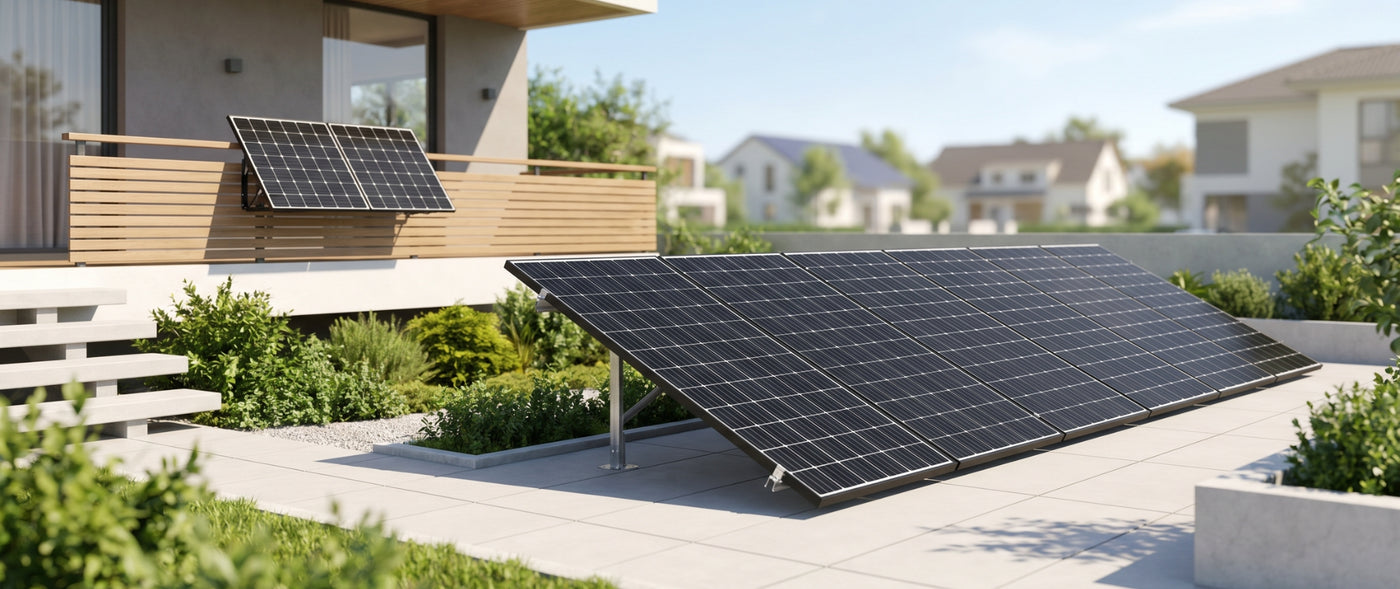
Solar panels are the revenue source of every photovoltaic system. In the B2B environment, measurable performance, robust mechanics, and clean documentation are key. Electricians, HVAC companies, planners, municipalities, and the housing industry use modules on flat roofs, pitched roofs, facades, and carports to increase self-consumption and reduce operating costs. Commercial businesses benefit from constant daily load profiles through east-west arrays, while residential areas often prioritize a homogeneous full black aesthetic. Industry and logistics utilize large field installations with high snow load and wind uplift reserves, often with bifacial modules on light-colored surfaces for additional kilowatt-hours. For mobile applications such as camping or autonomous remote sites, lightweight panels with twelve-volt systems and flexible designs are used. We supply project-ready bills of materials across all brands, verified datasheets, and installation support to ensure rollouts succeed on schedule and the planned performance ratio is achieved.

Selection criteria and buying guide
The right module choice starts with cell technology. Monocrystalline PERC modules are established and economical. N-type TOPCon and HJT increase efficiency, reduce degradation, and provide better yields at low temperatures and diffuse light. Half-cells reduce electrical losses. Bifacial variants also use the back side and increase yield on reflective surfaces. For the laminate, film-glass is available for low weight and glass-glass for maximum long-term stability. In addition to the nominal power in watt-peak, the temperature coefficient, the MPP voltage range, the short-circuit and open-circuit values, and tested certificates according to IEC standards are important. For factory roofs, high mechanical loads and a stable frame geometry are crucial; for residential buildings, design and homogeneous coloring play a role. For facades, fire protection, rear ventilation, and documentation are essential. We provide support with string planning, substructure, cable dimensioning, and coordination with the intended inverter, so that the system operates within the planned voltage window and monitoring transparently reports the yields.
Frequently Asked Questions
Welche Solarpanele eignen sich für Balkonkraftwerk, Garten, Camping und Powerstation?
Welche Solarpanele eignen sich für Balkonkraftwerk, Garten, Camping und Powerstation?
Für ein Balkonkraftwerk eignen sich meist starre oder flexible Solarpanele mit hoher Modulleistung und passender Halterung. Für Garten, Camping, Wohnmobil und mobile Stromversorgung sind faltbare Solarpanele oder leichte flexible Solarmodule besonders praktisch. Entscheidend sind Leistung in Wattpeak, Anschlussart, Gewicht, Wetterfestigkeit und Kompatibilität mit Wechselrichter, Laderegler oder Powerstation.
Was ist der Unterschied zwischen einem starren, flexiblen und faltbaren Solarpanel?
Was ist der Unterschied zwischen einem starren, flexiblen und faltbaren Solarpanel?
Starre Solarpanele sind besonders robust und eignen sich für Dächer, Balkonkraftwerke, Carports oder feste PV-Anlagen. Flexible Solarpanele sind leichter und können je nach Untergrund besser auf gewölbten oder mobilen Flächen eingesetzt werden. Faltbare Solarpanele sind ideal für Camping, Outdoor, Garten und Powerstations, weil sie transportabel sind und bei Bedarf schnell aufgestellt werden können.
Welches Solarpanel passt zu meiner Powerstation von Anker, EcoFlow, BLUETTI oder Zendure?
Welches Solarpanel passt zu meiner Powerstation von Anker, EcoFlow, BLUETTI oder Zendure?
Das passende Solarpanel für eine Powerstation muss zur maximalen Eingangsleistung, Spannung und Anschlussart der Powerstation passen. Wichtig sind die Angaben zu Watt, Leerlaufspannung, MPP-Spannung und Steckertyp, häufig MC4 oder passende Adapter. Für mobile Anwendungen sind faltbare Solarpanele mit 60 bis 200 Watt beliebt, während größere Powerstations auch mit leistungsstärkeren Solarmodulen kombiniert werden können.
Wie viel Watt sollte ein Solarpanel für ein Balkonkraftwerk haben?
Wie viel Watt sollte ein Solarpanel für ein Balkonkraftwerk haben?
Für ein Balkonkraftwerk werden häufig Solarpanele mit hoher Leistung pro Modul genutzt, damit auf begrenzter Fläche möglichst viel Solarstrom erzeugt wird. Entscheidend ist nicht nur die Modulleistung in Wattpeak, sondern auch die zulässige Wechselrichterleistung, die Ausrichtung, Verschattung und Montagefläche. Bei steckerfertigen Solaranlagen sollten die aktuellen Vorgaben für Modulleistung, Wechselrichter und Registrierung beachtet werden.
Was bedeutet Wattpeak bei Solarpanelen?
Was bedeutet Wattpeak bei Solarpanelen?
Wattpeak, abgekürzt Wp, beschreibt die Nennleistung eines Solarpanels unter standardisierten Testbedingungen. Ein Solarpanel mit hoher Wattpeak-Leistung kann bei gleicher Fläche mehr Strom erzeugen, wenn Ausrichtung, Sonneneinstrahlung und Temperatur passen. Für die reale Stromproduktion sind zusätzlich Standort, Neigungswinkel, Verschattung, Temperaturkoeffizient und Qualität des Wechselrichters wichtig.
Which are the best photovoltaic modules?
Which are the best photovoltaic modules?
That depends on the goal. Highest efficiency: often n-type (TOPCon/HJT). Best aesthetics: Full-Black. Longevity: frequently glass-glass. For area productivity in commercial settings, 500–600 W is sensible if the substructure is suitable.
Glass-glass or glass-foil?
Glass-glass or glass-foil?
Glass-glass is durable and stable against degradation, but heavier. Glass-foil is lighter and often cheaper. The decisive factors are the installation location, structural integrity, and TCO.
Do bifacial solar panels offer advantages when used on roofs?
Do bifacial solar panels offer advantages when used on roofs?
Only with rear irradiation. On closed roofs, the additional yield is usually low. Raised systems/open spaces with bright surfaces can be worthwhile.
What size fits on typical roofs?
What size fits on typical roofs?
Residential/small commercial installations mostly use 400–470 W modules. More important than Wp is the feasibility of installation: dimensions, frame thickness, and clamping areas must fit the grid.
How often to clean?
How often to clean?
In case of significant soiling or yield deviations. Plan visual inspections, compare strings in monitoring and clean according to manufacturer's instructions.

Solar Panels for Professional Photovoltaic Projects
Significance and Applications of Modern Solar Panels
Solar panels are the central energy source of any photovoltaic system. Companies, municipalities, housing associations, and installation companies use them to transform rooftops, facades, carports, and open spaces into predictable power sources. With suitable module outputs between 350 and 550 watt-peak per module, small self-consumption systems can be realized, as can commercial roofs with several hundred kilowatt-peak. In the housing industry, facade solutions and balcony installations are gaining importance, while commercial businesses often install panels on low-pitched east-west facing roofs to achieve a more consistent daily power curve. For municipal properties, robust design, reliable warranties, and transparent documentation for funding landscapes are crucial.
Overview of Cell Technologies and Module Construction
The market is dominated by monocrystalline PERC and TOPCon cells. Both technologies offer high efficiencies with stable degradation. Heterojunction cells combine amorphous and crystalline silicon and achieve excellent yields at low temperatures and diffuse irradiation. Half-cut cells reduce ohmic losses and improve low-light performance. Bifacial variants utilize both the front and back sides of the cell. In reflective environments or on bright flat roofs, this noticeably increases specific yields. For the laminate, foil-glass or glass-glass is used. Foil-glass panels are lightweight and cost-optimized. Glass-glass constructions offer very good long-term stability, low degradation, and high mechanical load capacity. The frame is usually made of anodized aluminum. Full black versions appeal to projects with high design requirements, for example, for prestigious buildings.
Properly Interpreting Performance Data
The watt-peak rating indicates the nominal power under standard test conditions. For planning, the temperature coefficient, open-circuit voltage, MPP voltage, short-circuit current, and MPP current are also relevant. A low temperature coefficient improves operation in summer heat. A wide MPP voltage range simplifies string design and ensures that the inverter operates optimally over wide ranges. The low-light performance determines how well the module produces in the morning hours, under cloudy conditions, and during transitional seasons. Certified datasheets with measurement curves form the basis for any serious design.
Mechanics, Dimensions, and Load Assumptions
Standard modules with 60 to 72 cells often range between one and two square meters and weigh between eighteen and twenty-three kilograms depending on the design. For flat roofs and open spaces, high snow load and wind uplift values are crucial. On pitched roofs, the bending stiffness of the frame also comes into play. Glass-glass variants show advantages here. For facade mounting, fire protection, rear ventilation, and penetration-free design play a role. All panels in our assortment are tested according to IEC standards for mechanical load, PID resistance, and humidity-heat cycles. This reduces yield losses over the entire lifespan.
Yield Optimization through Appropriate Project Layout
Yield arises from the sum of many details. A south orientation provides high peaks, while an east-west alignment creates a flatter curve that often better serves self-consumption in commercial processes. On flat roofs, low mounting systems can avoid shading and maximize the number of modules. For facades, projects in the heating period benefit from steep inclinations with higher winter yields. Bifacial panels unleash additional power on bright surfaces. In areas with partial shading, module optimizers or clever string design reduce losses. For balconies and railings, a secure clamping solution that allows a defined tilt angle and reliably dissipates wind loads is crucial.
Quality Assurance, Traceability, and Warranties
Professional procurement focuses on verified production lines, reliable serial numbers, and strong warranties. Product warranties of twelve to twenty-five years are common, as are linear performance warranties of up to thirty-five years. Manufacturers with independent audits and regular laboratory tests deliver consistent quality. Each batch is sampled upon arrival. Electroluminescence images reveal microcracks and cell damage. This way, projects achieve the planned performance ratio and ensure reliable cash flows for investors.
Sustainability and Material Cycle
Photovoltaics not only reduces energy emissions. Modern panels are increasingly produced in energy-optimized factories with a high proportion of renewable process energy. Glass-glass constructions do without backsheets made of fluoropolymers. European return systems ensure the recycling of glass, aluminum, and silicon. Forward-looking project planning considers travel distances, packaging reduction, and shared logistics for substructure and cables. This reduces costs and improves the ecological balance.
Selection by Application and Environment
Commercial flat roofs require modules with high load capacity and good backside reflection. Residential buildings often demand inconspicuous full black variants. For agriculture and industrial halls, panels with reinforced frames and robust glass are recommended. In coastal regions, the corrosion resistance of the frames plays a role. For facades, fire behavior must be checked according to national regulations. For balconies and smaller self-consumption systems, compact dimensions and low mass are important. Our product filters help with targeted selection based on cell technology, power class, design, dimensions, and certification.
Detailed Planning and Dimensioning
The design begins with an assessment of the roof or facade area. This determines the possible number of modules, the string plan, and the DC sum. Dimensioning considers the MPP voltage window and the maximum input voltage of the intended inverters. In warm regions, summer voltages must be considered, and in cold regions, increased open-circuit voltages in winter. Shading from parapets, chimneys, roof superstructures, or neighboring buildings is minimized in the layout. A simulation with location-specific weather data provides a realistic annual forecast. This leads to an economic viability calculation with self-consumption rate, remaining consumption, feed-in quantities, and load shifting by consumers such as charging points or heat pumps.
Installation, Substructure, and Electrical Wiring
Installation depends on the supporting layer and roof structure. On tile roofs, rails with roof hooks are used. On sheet metal roofs, hanger bolts or caps are used. On flat roofs, ballasted systems ensure the correct tilt angle, wind stability, and drainage. All clamps grip within the specified areas of the module frame. The electrical connection follows the specifications in the datasheet. Parallel strings of identical length maintain current symmetry and avoid losses. Cable routes remain short, cross-sections are designed for current and voltage drop. Overvoltage protection on the DC and AC sides, as well as proper grounding, complete the installation. After completion, a commissioning report documents all measured values and serial numbers.
Performance Monitoring and Operation
Clean monitoring makes yields transparent and ensures economic operation. Modern data loggers provide real-time values for voltage, current, and temperature. Analysis detects deviations early and allows for targeted maintenance. Cleaning is relevant to varying degrees depending on the location. In urban environments, occasional checks are sufficient. In agriculture, industry, or with low inclinations, regular cleaning can significantly boost performance. Glass-glass panels show particularly stable aging behavior in the field. Degradation due to light and temperature remains low. This way, the projected yields remain achievable over many years.
Economic Efficiency, Prices, and Procurement
The module price strongly affects project profitability but is not the sole decisive factor. The specific energy production per installed euro is crucial. Higher efficiencies allow more power on limited areas and reduce installation costs per kilowatt-peak. Robust panels reduce service expenses and minimize the risk of failure. Our offers consider graduated prices, delivery times, batch security, and coordinated logistics. For tenders, we provide datasheets, certificates, and acceptance protocols. For subsidized projects, we provide proof of compliance with the respective funding conditions. This ensures quick and auditable processing.
Solar Panels in Conjunction with Energy Management
The full benefit arises when module performance meets the site's load profile. In commercial businesses with daytime loads, an east-west orientation provides high self-consumption. In residential areas, a south orientation is suitable in combination with storage and load shifting. Interfaces to smart meters, energy management, and charging infrastructure ensure priorities and controls that cut network peaks and increase self-consumption rates. For heat pumps and commercial refrigeration, generation and consumption can be well coupled. Thus, the module on the roof becomes a component of an integrated energy supply.
Selection Guide by Surface Type
For pitched roofs on single-family homes, high-performance modules with an appealing aesthetic are suitable. For large hall areas, high area performance and robust frames are important. For facades, lightweight constructions and black designs provide a harmonious appearance. For carports and parking lot roofs, high glass strength is important. For balconies, compact dimensions and secure mounts play the main role. In all cases, we advise on string planning, mounting systems, and necessary verifications. This ensures that the result is technically and economically convincing.
Safety, Standards, and Documentation
All panels comply with relevant IEC standards and are traceable with serial numbers. In Germany, plant construction follows VDE rules and network operator specifications. Complete documentation includes datasheets, certificates, string plans, measurement protocols, and photos of the installation. For larger roofs, fire protection and static proofs may be required. Our project documents support acceptance by operators, inspectors, and insurance. This turns planning into a reliable system with clear obligations and rights.
Perspective, Innovation, and Delivery Capability
The module market is evolving rapidly. Cell sizes and interconnections change, efficiencies continue to rise. At the same time, delivery capability remains a critical factor. We keep common power classes in stock and secure the required batches for projects early on. Manufacturer roadmaps provide planning security over product cycles. Early planning avoids design changes during the construction phase and results in a homogeneous field with identical appearance and performance.
Why Solar Panels from This Assortment
Our selection covers the requirements of professional users. You will find monocrystalline panels with high area performance, glass-glass versions for demanding locations, and bifacial models for reflective environments. Each product has verified data, traceable warranties, and clear documentation. Together with the substructure, cable set, and optional energy monitoring, a harmonious all-in-one solution is created. Procurement, logistics, and service are geared towards the processes of specialized companies, housing associations, and commercial operators.
Conclusion for the Procurement of Solar Panels
Solar panels determine the energy yield and visual impression of a photovoltaic system. Those who carefully evaluate cell technology, design, load assumptions, and electrical characteristics achieve high specific yields and stable operating costs. With an adapted orientation, a well-thought-out substructure, and reliable monitoring, you secure generation and availability over the entire lifespan. Our assortment provides the suitable basis for this. In this way, every available area reliably produces renewable energy, which reduces costs and makes climate goals achievable.