


 Sold out
 Sold out
 Sold out
 Sold out
 Sold out


 Sold out
 Sold out
 Sold out


 Sold out
 Sold out
 Sold out
 Sold out
 Sold out


Guidelines for Trades, Housing Industry, and Commerce
In craft businesses, rapid assembly and reliable availability are crucial. Pre-assembled solar cables with suitable connectors shorten deployment times on pitched roofs and ensure safety during acceptance. Housing associations and homeowner associations rely on standardized cable lists for balcony power plants, rooftop systems, and central storage units. Uniform cross-sections, clear color coding, and documented measurement values simplify maintenance and fleet operation. Commercial sites require durable cables in long runs and a clear separation of DC, AC, and data. Agriculture, industrial halls, and parking garages demand high UV stability, resistance to ammonia, and practical strain relief on racks and penetrations. Municipal properties benefit from halogen-free cables and tested fire protection classes, as special regulations often apply here. For temporary power supply at events or construction sites, robust connection cables and weather-resistant data connections provide a stable basis.

Cross-section, voltage drop, and environment
The selection begins with the energy flow. The suitable cross-section is determined from module output, string current, and cable length. Four square millimeters work for short distances and moderate currents, while six square millimeters or more are recommended for longer routes and high power. The permissible voltage drop per string should be kept small so that the inverter works efficiently. In warm attics and in bundled cable runs, the current carrying capacity decreases. These general conditions must be included in every calculation. On the AC side, the cross-section depends on the fusing, cable length, and future expansion with storage or a wallbox. The environment determines the sheath material. Outdoor areas, stables, or coasts require cross-linked, UV and ozone-resistant insulation. In technical rooms, halogen-free versions with documented fire classification are useful. Structured network cables or fiber optics are planned for monitoring and control. Those who connect several buildings benefit from surge protection and equipotential bonding. Suitable accessories for strain relief, roof penetrations, and terminals complete the installation.
Frequently Asked Questions
What cross-section is suitable for solar cables
What cross-section is suitable for solar cables
The decision depends on string current, cable length, permissible voltage drop and ambient temperature. In small systems with short runs, four square millimeters are often sufficient. Longer routes or high currents call for six square millimeters or more. The aim is a small voltage drop per string so that the inverter remains in the optimal operating range.
How do DC PV cables differ from standard installation cables?
How do DC PV cables differ from standard installation cables?
Solar cables according to IEC 62930 are double insulated, halogen-free, flame-retardant and highly UV resistant. They are designed for permanent movement, strong temperature changes and humidity. Conventional installation cables are not designed for this and should not be used on the DC side.
How long can string lines be
How long can string lines be
The length is limited by the permissible voltage drop. The larger the cross-section, the longer the cable can be. In practice, a voltage drop of one to two percent per string is aimed for. A calculation including module power, string current, cable length and ambient temperature provides the appropriate value.
May AC and DC cables be run in the same conduit?
May AC and DC cables be run in the same conduit?
For reasons of EMC and clarity, it makes sense to separate direct current, alternating current, and data. Many installation standards require separate routing. It also simplifies later inspections and reduces the risk of incorrect connections.
Which connectors are suitable and what tools do I need
Which connectors are suitable and what tools do I need
MC4-compatible connectors are used for most modules and inverters. Crucial are suitable contacts for the chosen cross-section and a calibrated crimping tool. A correctly crimped contact and an intact sealing system ensure a permanently tight and low-resistance connection. We can supply you with pre-assembled extension cables including a test report if you do not have your own crimping pliers.

Energy and connection cables for photovoltaics with maximum system availability
Role of Cables in the Overall PV System
Power and connection cables form the infrastructure of every photovoltaic system. They transport the generated DC current from the module array to the inverter, connect inverters, storage units, and meters on the AC side, and enable reliable monitoring via data cables. The quality, cross-section, and installation method of the cables determine yield, safety, and service life. Proper planning here reduces voltage drop, avoids hotspots, accelerates installation, and secures warranty claims against manufacturers and insurers.
Standards, Materials, and Approvals
Professional solar cables comply with the international standard IEC 62930. In Europe, materials and tests are anchored in the former EN 50618, which continues to serve as a market reference. The common cable type H1Z2Z2 K features double insulation made of cross-linked polyolefin, a halogen-free and flame-retardant design, excellent UV and ozone resistance, and high notch resistance. The cables are designed for continuous outdoor use, on the roof, and in cable ducts. Temperature fluctuations from minus forty to plus ninety degrees, as well as moisture, salt, and ammonia in agricultural environments, are reliably managed. On the AC side, depending on the installation situation, rubber-sheathed cables, sheathed cables, or halogen-free installation cables are used. For buildings with special requirements, classification according to the Construction Products Regulation with reaction classes Eca, Dca, or Cca is relevant.
Dimensioning of DC String Cables
The cross-section of a PV cable depends on the operating current, cable length, permissible voltage drop, and ambient temperature. In small systems, four square millimeters are often sufficient; for longer routes or high currents, six square millimeters is the better choice. In commercial projects with multiple strings and long busbars, eight or ten square millimeters are used. The goal is a voltage drop per string in the range of one to two percent so that the inverter operates in the optimal MPP window. Shading, bundling, and increased ambient temperatures reduce current carrying capacity. These factors should be considered in the calculation. For busbars from the generator junction box to the inverter, a separate consideration is useful, as different thermal conditions apply here.
Cables on the AC Side
Alternating current flows between the inverter, storage unit, wallbox, smart meter, and grid connection point. The selection of cables is based on the installation method, fusing, short-circuit resistance, and fire protection. Flexible connection cables facilitate device replacement in technical rooms, while rigid sheathed cables are suitable for fixed installations. For outdoor areas, robust rubber cables or halogen-free variants with increased UV resistance are used. The cross-section depends on the fusing, cable lengths, and permissible voltage drop. For three-phase feeds, symmetrical design must be observed. Clear wire identification and correct PE and PEN routing ensure acceptance.
Connectors and Assembly
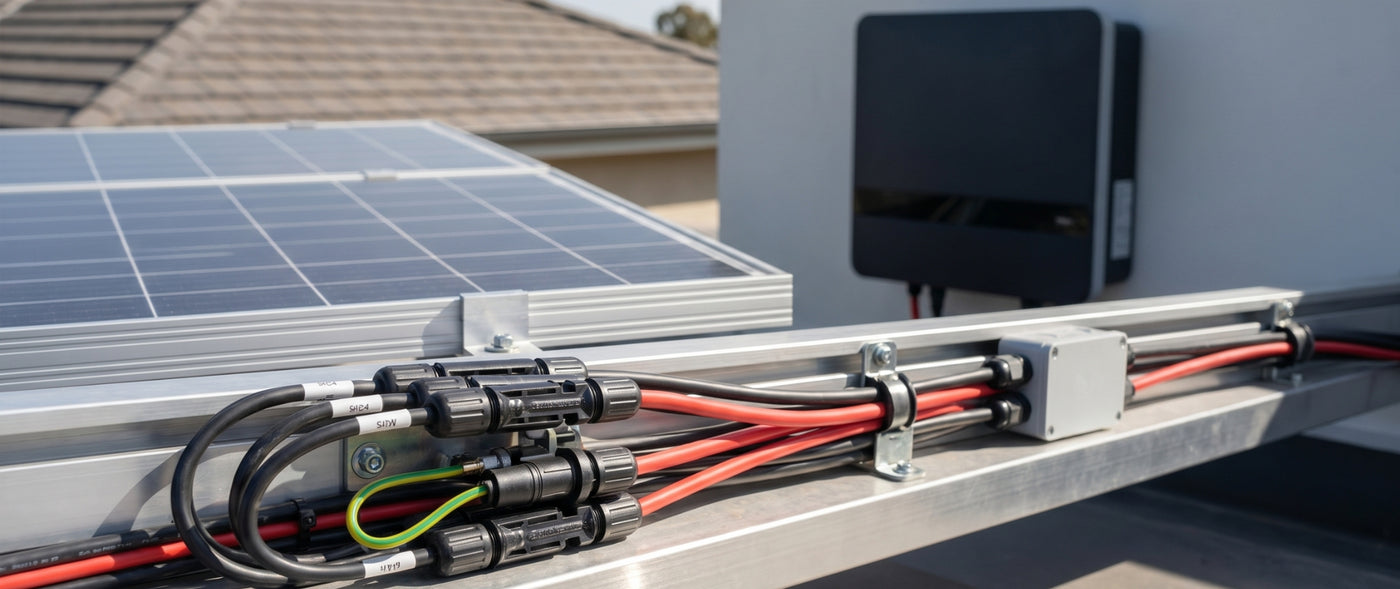
Modern PV connectors provide a permanently sealed and low-resistance connection. The widely available MC4-compatible systems are tested for outdoor use and high cycle counts. Crucial is the combination of suitable contacts, correctly crimped cables, and a sealing system with adequate IP protection. Those who use pre-assembled cable sets benefit from reproducible quality and reduced installation times. For service assignments at height, pre-assembled extension cables with labeled ends are a reliable solution. In commercial environments, pre-assembled sets facilitate standardization across many roofs.
Grounding, Potential Equalization, and Lightning Protection
In addition to power transmission, cables also perform protective functions. Module frames and mounting structures are conductively connected via grounding cables and potential equalization bars. The cross-section is determined by the normative current carrying capacity in case of fault and by mechanical stress. In buildings with external lightning protection, the separation from conductive parts and integration into the lightning protection system must be planned. The selection of suitable connection elements and correct protection against contact corrosion extend the service life. Clear labeling of protective conductors creates transparency during maintenance and recommissioning.
Cable Management and Installation
Even the best cable is of little use without proper installation. On the roof, UV-stable cable ties and clamps prevent chafing on sharp edges. Cables must not lie in water and require sufficient distance from hot components. In shafts and conduits, fill levels and bending radii must be observed. For parallel cable runs, DC and AC are routed separately to minimize interference. In technical rooms, numbering and terminal diagrams ensure traceable wiring. Careful documentation with measurement protocols of insulation resistances simplifies subsequent inspections.
Data Cables for Monitoring and Control
Photovoltaics and storage systems are now monitored via IP networks. Network cables, fiber optics, or shielded serial cables connect inverters, data loggers, meters, and energy management systems. For interference-free transmission in buildings with power supplies, motors, and frequency converters, shielded cables are advantageous. Long distances can be bridged with fiber optics. Structured cabling with patch panels in the meter cabinet accelerates service work. For outdoor areas, weatherproof cables and sealed couplings ensure availability.
Efficiency through Standardization
In B2B projects, standardization determines installation time. When cable cross-sections, connectors, and lengths are unified in the portfolio, error rates and storage costs decrease. Pre-assembled sets for typical roof geometries save time on the construction site. Serial numbers and labels accelerate documentation. In residential areas and branch networks, rollouts can be planned precisely. The measurable effect is seen in shorter installation times, simpler training, and robust spare parts management.
Sustainability, Maintenance, and Service Life
Durable cables reduce resource consumption and service trips. UV-stable, halogen-free, and flame-retardant materials increase safety in the building and improve behavior in case of fire. Careful planning of cable routes avoids retrofitting costs for storage and charging infrastructure. Maintenance-friendly accessibility, clearly legible labels, and documented measured values are the basis for a long service life. At the end of their life cycle, copper and aluminum can be recycled economically.
Quality Assurance and Acceptance
Before handing over a system, cables are mechanically inspected, polarity is verified, and insulation resistance is measured for each string. The measured values are documented along with the cable lengths. This data serves as a reference for later comparisons. On the AC side, loop impedances, continuity of the protective conductor, and RCD tripping currents are recorded. Thorough documentation enhances traceability towards the grid operator, insurance company, and end customer.
Future-Proof Infrastructure
Photovoltaics are growing into an energy system with storage, heat pumps, and charging points. Those who plan cable routes correctly today will save a lot of effort later. Larger cross-sections for busbars, reserve shafts and empty conduits, additional patch panels, and space for surge protection and current transformers make systems expandable. A well-thought-out infrastructure increases the attractiveness of the property and facilitates operation for decades.
Our Range of Power and Connection Cables
This category bundles solar cables for the DC side, robust cables for AC power, pre-assembled extensions, adapter cables, Y-assemblies, grounding cables, as well as network cables and accessories for safe installation. All products are tested for professional applications. For series projects, we supply pre-assembled sets including test protocols and labeling. Technical consultation on cross-section, voltage drop, and installation method is available upon request.