


 Sold out
 Sold out


Mounts for professional projects with clear TCO
Substructures must function in everyday use. Electricians, roofers, energy planners, and general contractors expect quick assembly, few different parts, and reliable documentation. Housing associations and homeowners' associations require standardized packages for recurring roof shapes and defined installation documents for property files. Commercial operators rely on flat aerodynamics, tested ballasting, and clean cable routes to ensure low-maintenance operation. Municipal properties prioritize fire protection, lightning protection, and clear maintenance access. For all groups, the total cost consideration over the lifecycle is crucial. A well-designed mounting system reduces installation time, lowers risk, and provides stable returns.

System selection with a focus on structural integrity and installation time
The right solution is derived from the roof type, load assumptions, and module geometry. Design aids lead to suitable rail spacings, clamps, and ballast quantities. Pre-assembled components, defined torques, and clean cable routing reduce effort on site. Our consulting combines static safety with high installation speed and provides a complete bill of materials for ordering.
Frequently Asked Questions
Which mounting system suits my roof
Which mounting system suits my roof
The choice depends on the roofing material, rafter spacing, roof pitch, and permissible load. Tiled roofs generally use roof hooks, sheet metal and fiber cement use hanger bolts, and flat roofs use elevated systems. A brief analysis of the geometry leads to the appropriate bill of materials.
How is the necessary ballasting on flat roofs determined
How is the necessary ballasting on flat roofs determined
The amount of ballast required depends on the wind zone, building height, edge distances, roof pitch, and system geometry. Manufacturers provide calculation models that take these parameters into account. The Eurocodes with national annexes form the basis. The result is a plan with distributed loads that respects the roof statics.
Do I need roof penetrations
Do I need roof penetrations
Many flat roof systems are ballasted and do not require penetration. On pitched roofs, fasteners are necessary for the supporting structure. Sealing collars and suitable molded parts secure the waterproofing. The decision depends on the roof structure and statics.
What distances must be observed when clamping the modules
What distances must be observed when clamping the modules
The clamping points are within the zones approved by the module manufacturer. These define edge clearances and the position of the center and end clamps. Deviations can lead to frame deformations and jeopardize the warranty. The module's installation instructions are binding.
How do I prevent corrosion on the substructure?
How do I prevent corrosion on the substructure?
Aluminum profiles and stainless steel screws provide a robust base. Contact corrosion is avoided by using suitable spacers and neatly separated metals. Water-carrying areas are designed openly so that no moisture remains. Regular visual inspections ensure the condition over the entire service life.

Durable PV mounts for maximum yields and long service life
Purpose of the Substructure
Mounting systems bear the mechanical responsibility in a photovoltaic system. They transfer wind and snow loads to the building, hold module arrays at the optimal angle, and protect the roof membrane. An appropriate substructure prevents micro-movements and thus frame cracks, secures the module clamping zones, and reduces cable runs. Those who correctly select mounting systems gain measurable yield, minimize service calls, and meet the requirements of insurance, structural engineering, and grid operators.
Roof Types and Suitable Systems
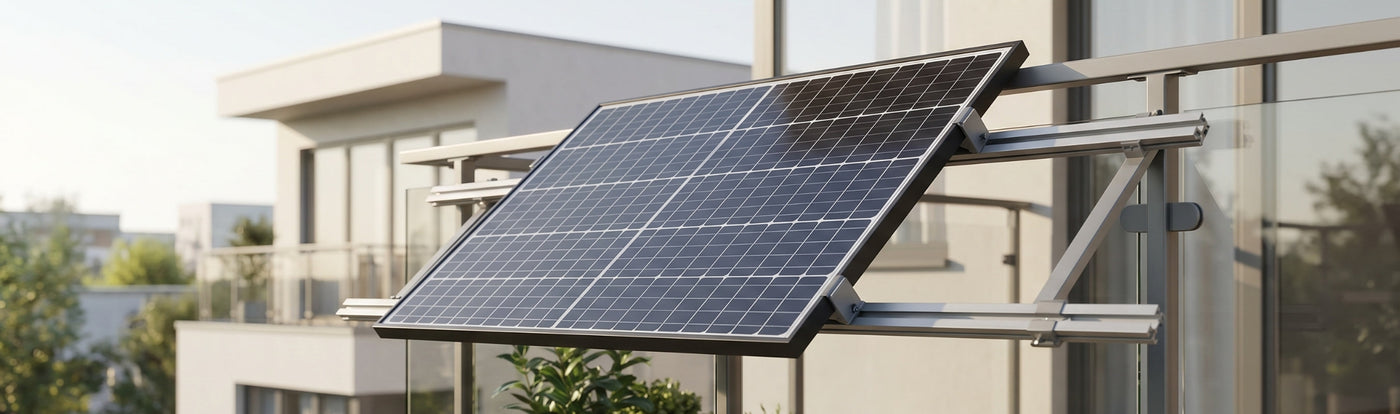
Pitched roofs are usually realized with rail systems. Roof hooks for tiled roofs or hanger bolts in wood and steel profiles safely transfer forces into the rafters. The rails accommodate mid and end clamps and allow for thermal expansion. Flat roofs benefit from elevated systems with a defined tilt. Ballast pans and aerodynamics dissipate wind uplift forces without damaging the roof waterproofing. Facade mounts support modules vertically or at a slight incline and are suitable for commercial facades and parking structures. For carports and open spaces, pre-punched profiles provide quick installation. Balcony railings receive modular mounts with approved clamps and secure load transfers. In all cases, module dimensions, frame height, and clamping zones specified by the manufacturer must be observed.
Materials and Corrosion Protection
Substructures predominantly consist of aluminum profiles with high strength and low weight. Connecting components such as screws, nuts, and washers are generally made of stainless steel grades A2 or A4. In contact areas, galvanic separation helps prevent contact corrosion. On roofs with aggressive atmospheres, additional surface protection is recommended. Elastic interlayers between hooks and roof battens distribute the load and prevent noise. Sealing sleeves and permanently elastic molded parts protect the roof membrane at penetrations.
Static Planning and Proofs
The design is based on the site loads from the Eurocodes and their national annexes. Wind and snow are evaluated zonally, as are building height and edge location. Manufacturers provide tables and design aids that define the number of roof hooks, rail spacing, and ballast quantities. For commercial and housing projects, documented proofs are required. These include a bill of materials, structural calculation, installation instructions, and a log with torque values and photos. Thorough documentation speeds up acceptance and serves as reliable evidence in case of damage.
Installation Practice with a Focus on Time and Safety
Installation teams appreciate a low variety of parts, pre-assembled clamps, and clear click mechanisms. A standardized tool kit with defined torque values prevents installation errors. Work on the roof follows a fixed procedure: securing pathways, checking the roof membrane, measuring the field, setting hooks or screws, aligning the rails, laying cables, clamping modules, and documentation. Personal protective equipment against falls and professional access technology are mandatory. Each clamping connection is tightened to the specified torque and marked.
Fire Protection, Lightning Protection, and Potential Equalization
Local fire protection regulations apply in technical rooms and on roofs. Mounting systems and cable routes are routed so that escape and rescue routes remain clear. Metal rails and module frames must be conductively connected and integrated into the potential equalization system. Buildings with external lightning protection require coordination with the lightning protection planner. Sufficient separation distances and tested connectors prevent flashovers. Halogen-free components are sensible in sensitive areas.
Economic Efficiency through Standardization
B2B projects benefit from recurring components. Uniform rail lengths, clamp types, and fasteners reduce storage complexity and training effort. Pre-packaged sets for typical rafter spacings accelerate installation and reduce the risk of errors. Serial numbers, labels, and digital installation data facilitate handover to clients and service. This creates a scalable installation chain for neighborhoods, branch networks, and municipal roofs.
Compatibility with Modules, Inverters, and Storage Units
The substructure defines the distance to the roof membrane and thus the airflow under the modules. Good rear ventilation lowers cell temperatures and increases performance. Cable holders, penetrations, and protective conduits are part of the system and safely guide DC cables to collection points. On flat roofs, well-planned cable routing creates short paths to the inverter. Space is provided for storage units and wall boxes on cable trays and in cable ducts. Clean planning prevents crossovers of DC, AC, and data lines.
Sustainability and Life Cycle
Durable mounting systems avoid material and travel over decades. Aluminum profiles can be recycled, and stainless steel screws are fully recyclable. A low-corrosion design with good drainage extends the service life of the roof membrane. Penetration-free flat roof systems respect the structure of the waterproofing and save on maintenance. Planning reserves for later expansions in advance reduces subsequent modifications.
Service and Maintenance
After commissioning, visual inspections are useful. These include checks of clamps, rail connectors, and cable holders. A fixed maintenance schedule covers changes to the building, storm events, or unusual snow loads. Clear logs with photos and measurements create transparency. A modular design facilitates the replacement of individual parts without extensively opening the field.
Our Product Range for Mounts
This category bundles substructures for pitched roofs, flat roofs, facades, carports, and balconies. You will find roof hooks, hanger bolts, rails and connectors, end and mid clamps, elevated systems with defined tilts, ballasted systems, railing mounts, and suitable accessories for cables and penetrations. All components are designed for professional installation. For series projects, we supply pre-assembled kits with documented load-bearing capacity and a clear bill of materials. Technical advice on load assumptions, design, and installation methods is available upon request.